Guide
How Pay-As-You-Go Car Insurance Works
The two models behind pay-as-you-go car insurance—pay-per-mile and behaviour-based telematics—how premiums are calculated, and how the devices and apps collect data.

By Jordan Ellis · Editor
Published · Updated
Answer in brief
"Pay-as-you-go" covers two different products. Pay-per-mile insurance charges a fixed monthly base (covering the car while parked) plus a per-mile rate, typically a few cents to around ten cents, measured by a plug-in device, the car's built-in connectivity or an app. Behaviour-based telematics charges a conventional premium adjusted by a driving score built from braking, acceleration, speed, phone use and time of day. Both are full, regular auto insurance policies with the same coverages; only the pricing input changes.
Pay-per-mile
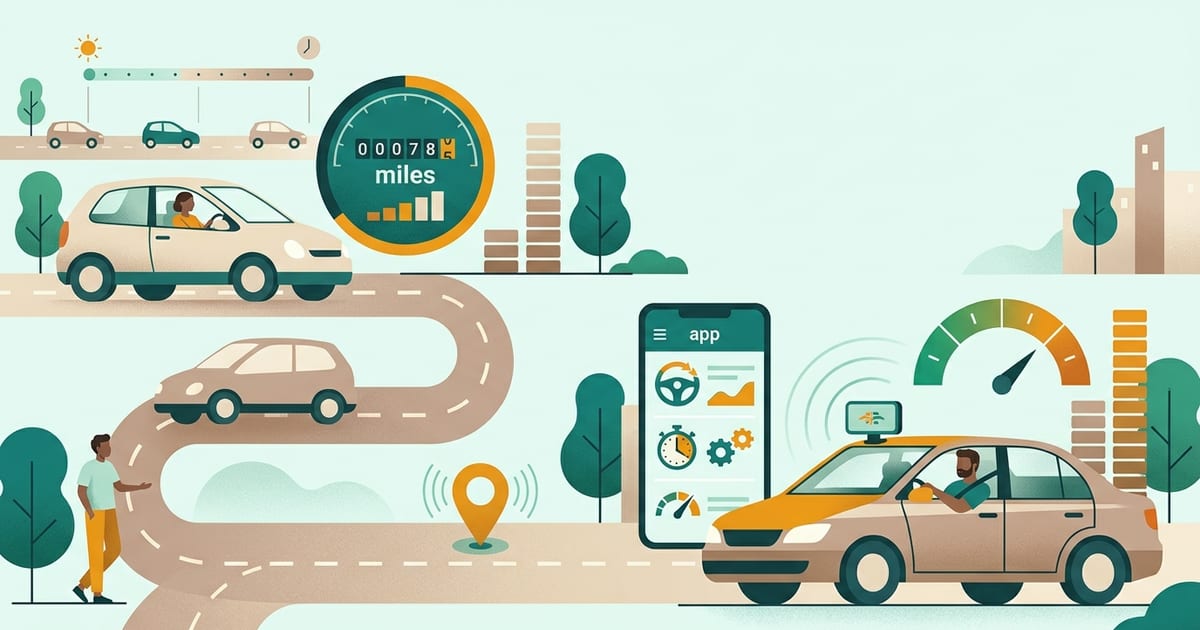
The premium has two parts. A base rate per month covers the risks that exist whether or not you drive—theft, weather, a tree falling on the car—and the fixed costs of the policy. A per-mile rate covers the risks of being on the road. Both are set from the usual factors: driver, vehicle, location, coverage. Miles are counted by a device plugged into the car's diagnostic port, by the manufacturer's connected-car system, or by a phone app, and most programmes cap the miles charged in a single day (often around 150–250) so a road trip does not produce an outsized bill.
Behaviour-based telematics
Here the premium is conventional, but an app or device records how you drive and produces a score. Hard braking, rapid acceleration, speeding, phone handling and late-night driving lower it; smooth, daytime driving raises it. Most programmes give an enrolment discount, then adjust at renewal—some only downward, some in both directions. Mileage is usually one input among several rather than the basis of the price.
What stays the same
Everything about the coverage. Liability, collision, comprehensive, uninsured motorist, deductibles and claims all work exactly as on a standard policy. Pay-as-you-go changes how the price is calculated, not what you are buying.
Entries in this guide
Specific questions answered in more depth.
Questions & answers
Is pay-as-you-go insurance real insurance?
Yes. It is a standard auto policy with the same coverages; only the pricing input differs.
Do I pay per mile for every mile?
Up to a daily cap, typically 150–250 miles. Miles beyond the cap on a single day are not charged.
What if the device loses connection?
Programmes generally estimate from your history for short gaps and ask you to fix the connection for longer ones.
Terms used in this guide
- Pay-per-mile insurance
- A policy priced as a monthly base rate plus a per-mile charge for miles actually driven, measured by a device or app.
- Telematics (usage-based insurance)
- Pricing that uses measured driving data—mileage, braking, speed, time of day, phone use—collected by a device, connected car or app.
- Base rate (pay-per-mile)
- The fixed monthly portion of a pay-per-mile premium, covering risks that exist while the car is parked and the policy's fixed costs.
- Per-mile rate
- The charge for each mile driven on a pay-per-mile policy, typically 3–12 cents, subject to a daily cap.
- OBD-II device
- A small unit plugged into a vehicle's on-board diagnostics port that records mileage and, in some programmes, driving behaviour.
Sources and references
Legal figures on this page (minimum limits, filing periods, statutory benefits) are checked against the primary law or the state insurance regulator listed below. Links and figures last verified Nov 2026.
- Background on: Pay-as-you-drive auto insurance (telematics) — Insurance Information InstituteIndependent researchUsage-based and per-mile pricing models, what telematics programmes measure, and state limits on their use.
- Nine ways to lower your auto insurance costs — Insurance Information InstituteConsumer guidanceShop at least three quotes; raising a deductible from $200 to $500 can cut collision/comprehensive cost 15–30%, $1,000 can save 40%+; drop physical damage on cars worth under 10× the premium; bundling, low-mileage and good-student discounts.
- What is covered by a basic auto insurance policy? — Insurance Information InstituteConsumer guidanceDefines bodily injury and property damage liability, MedPay, PIP, uninsured/underinsured motorist, collision, comprehensive and glass coverage.
- What determines the price of an auto insurance policy? — Insurance Information InstituteConsumer guidanceRating factors: driving record, mileage, location, age, gender, vehicle, credit-based insurance score, coverage choices. Notes ZIP-code rating is prohibited in California and Michigan and gender rating is prohibited in seven states.
Practical guidance on this page is original editorial work. Cited sources support factual statements and do not endorse this site. Dollar ranges described as typical or illustrative are editorial estimates, not figures from these sources.
Guide
Pay-Per-Mile vs Telematics: Which Saves More?
A direct comparison of pay-per-mile and behaviour-based telematics—who each suits, how savings differ, and whether you can combine them.
Guide
Who Saves With Pay-As-You-Go Insurance
The driver profiles that benefit from pay-as-you-go pricing—remote workers, retirees, second cars, city dwellers, students—and the ones who should avoid it.
Guide
Privacy and Data in Pay-As-You-Go Insurance
What telematics devices and apps actually collect, how insurers use and share it, how long it is kept, and how to limit what you give up.